
Table of Contents
- Why Queensland Heat Is Hard on Any Decking Material
- Composite Decking Surface Temperature: Light vs Dark Boards
- Benefits of Light Coloured Decking in Full Sun
- Heat, Concrete, Fake Grass and Timber: What the Surface Feels Like
- How Solid Core Boards Handle Queensland Heat and Humidity
- Choosing the Best Composite Decking for Queensland Heat
- Frequently Asked Questions
Last Updated: September 30, 2026
Why Queensland Heat Is Hard on Any Decking Material
Choosing the best composite decking for Queensland heat starts with understanding what summer actually does to a board. Surface temperatures on exposed decking can climb far above the air temperature, and that heat stresses every material differently. This guide from Sun Decking breaks down how light and dark boards perform, how solid core construction handles humidity, and what to check before you buy.
Timber decking absorbs moisture, expands, and greys under intense UV. Concrete and fake grass store heat and release it slowly, so they stay hot well into the evening. Composite decking sits somewhere in between, and how well it copes depends on colour, core construction, and the surface technology used.
Composite Decking Surface Temperature: Light vs Dark Boards
Dark boards absorb more heat than light ones, and the gap is noticeable underfoot on a 35°C day. A dark charcoal board can feel uncomfortably hot in direct sun, while a light sand or white board stays closer to ambient temperature.
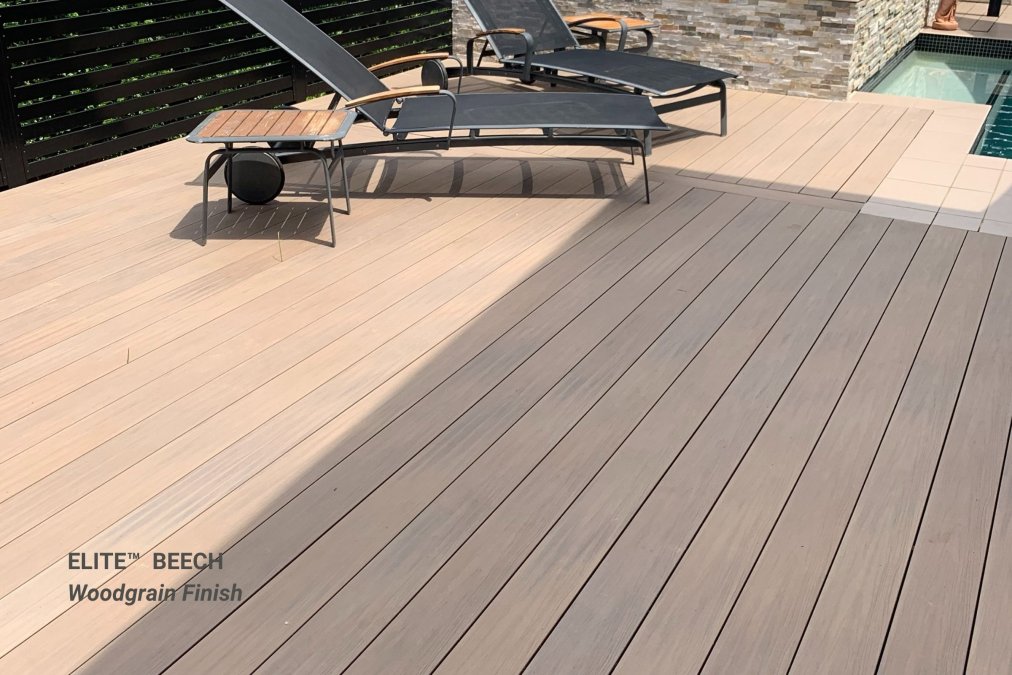
Heat absorption comes down to how much solar radiation a surface reflects. Light colours reflect more and absorb less, which keeps the surface cooler. Dark colours do the opposite, which is why a dark board in full afternoon sun can be too hot to stand on comfortably.
How Quickly Boards Cool When You Apply Water
A quick splash of water cools a hot composite board fast, often within a minute or two, because the water pulls heat off the surface as it evaporates. This is a practical fix for entertaining areas where a board has been baking all day.
The effect is temporary. Once the water evaporates, the board starts warming again if the sun is still on it. For a permanent fix, choose a lighter colour and add shade.
Benefits of Light Coloured Decking in Full Sun
Light coloured decking reflects more solar radiation, so it stays cooler and holds its colour longer in strong sun. White and pale boards perform closest to natural timber in terms of barefoot comfort.
- Lower surface temperature than dark boards
- Better colour retention under UV exposure
- Reduced heat build-up in the outdoor living space
- Easier to match with light-toned furniture and paving
For full-sun positions, a white or light board is the practical choice. It won’t eliminate heat, but it keeps the surface within a comfortable range for longer.
Heat, Concrete, Fake Grass and Timber: What the Surface Feels Like
On a still 35°C afternoon, the surface you stand on can be 20°C or more above the air temperature. How each material behaves comes down to two things: how much solar radiation it absorbs, and how much thermal mass it holds once it has absorbed it.
Concrete and fake grass are both high-mass surfaces.
On a practical comparison then our Elite Pure White board on a full sun summer day would be cooler than a timber stained board, we have temperature tested many times.
Once you move to the lighter tones, Light Grey, Oak and Beech then the temperature will be slightly higher than a timber stained deck. Comparatively they are still cooler than a tile, concrete or plastic grass option.
Once you use darker colours then they will be hotter than a timber, although even the darkest composites are similar to tiles or concrete on a hot day.
The heat differentials are a consequence of the composite being dense and having a plastic element, it is the trade off in characteristics that ensures the deck never rots or is attacked by termites.
|
Surface |
Heat Retention |
Barefoot Comfort |
Maintenance |
|---|---|---|---|
|
Concrete |
High, slow to cool |
Poor in full sun |
Low |
|
Fake grass |
High, slow to cool |
Poor in full sun |
Low |
|
Natural timber |
Moderate |
Good when sealed |
High |
|
White composite |
Low |
Good, closest to timber |
Low |
|
Light grey or sand composite |
Low to moderate |
Good |
Low |
|
Dark composite |
High |
Poor in full sun |
Low |
How Solid Core Boards Handle Queensland Heat and Humidity
Solid core boards resist heat and humidity better than hollow or capped alternatives because there is no internal cavity to trap moisture or weaken under thermal stress. The dense core holds its shape as temperatures swing from cool mornings to hot afternoons, and it does not rely on a thinner outer shell to carry structural load. It is not uncommon for us to see failed hollow boards that have been exposed to high sun next to pools. Generally they have cupped slightly over many heating cycles and create a split along the length where the board is thinnest.
Coastal humidity versus inland dry heat
The two climates stress composite boards differently, and the right board for one is not automatically right for the other.
- Coastal and near-coastal areas: salt air and high humidity keep ambient moisture levels elevated year-round. Boards stay damp longer after rain, mould pressure is higher, and the sub-structure needs generous airflow to dry out. Salt residue also dulls surface finish over time, so a board with a sealed cap and a light colour performs best, light boards stay cooler and show less salt bloom than dark ones.
- Inland and western areas: dry heat and wide day-night temperature swings are the dominant stress. Boards heat up faster in direct sun because there is less atmospheric moisture to soften the radiation, and they cool faster after sunset. The colour choice matters more here than anywhere else, because a dark board in full inland sun can be too hot to stand on for most of the afternoon.
Choosing the Best Composite Decking for Queensland Heat
Picking the best composite decking for Queensland heat comes down to three decisions: colour, core construction, and surface technology. Get those right and the board will handle the climate for years.
- Colour: choose light or white boards for full-sun positions to reduce heat absorption
- Core: solid core boards resist moisture and thermal stress better than hollow options
- Surface: UV-stabilised and capped boards resist fading and stay cooler
Frequently Asked Questions
Which composite decking handles Queensland heat best?
Solid core composite decking with a polymer shell and UV stabilisers holds up best in Queensland heat. The solid core resists moisture absorption and humidity, while the capped surface slows UV degradation and colour fade. Light and white boards stay noticeably cooler underfoot than dark boards because they reflect more sunlight instead of absorbing it. Sun Decking’s solid core range is built for these conditions and backed by a 15-year warranty.
Does composite decking get hotter than timber?
In direct summer sun, a dark composite board can feel hotter underfoot than pale natural timber because it absorbs more heat. Light and white composite boards behave much more like timber, staying cooler to walk on. Surface temperature also depends on colour, sun exposure and airflow beneath the boards, so board choice matters more than the material itself when barefoot comfort is your priority.
Is composite decking termite resistant?
Yes. Composite decking is made from wood-plastic composite, so it contains no solid cellulose for termites to eat. That makes it termite resistant, unlike natural timber, which needs ongoing treatment and inspection. In Queensland, where termite pressure is high, this removes a major maintenance worry. It also resists moisture absorption and humidity, so boards will not rot or swell the way untreated timber can.
How do light-coloured boards compare to dark boards in direct sun?
Light-coloured decking reflects more sunlight and absorbs less heat, so it stays cooler underfoot than dark boards on the same deck. White boards in particular cool as quickly as timber when you hose them down, making them a practical choice for poolsides and full-sun areas. Dark boards absorb more heat, which can make them uncomfortable on bare feet during peak summer afternoons.
Can you cool composite decking down with water?
Yes. Hosing down a hot deck drops the surface temperature quickly, and light or white boards cool almost as fast as timber. The effect is temporary, so the deck will warm again in direct sun. For lasting barefoot comfort, combine light colours with good sub-structure ventilation so air moves freely under the boards and helps moderate surface temperature.
How does composite decking compare to concrete or fake grass for heat?
Concrete and artificial grass both absorb and hold heat, and fake grass can feel uncomfortably hot on bare feet in full sun. Light composite decking reflects more heat and cools quickly with water, so it usually feels cooler than either. It also drains freely and resists moisture, which suits humid Queensland summers better than surfaces that trap heat and water.
What should I check before buying composite decking for a hot climate?
Look for a solid core, a capped polymer shell with UV stabilisers, and a colour that suits your sun exposure. Ask about thermal expansion and contraction, since boards move slightly in heat, and confirm the warranty covers fading and structural integrity. Sun Decking offers factory-direct pricing, 48-hour delivery and a 15-year warranty, so you can request a quote and compare options for your project.
Queensland summers test every decking material, and the wrong choice shows up fast as fading, heat, or movement. Sun Decking stocks solid core composite decking built for these conditions, backed by a 15-year warranty and 48-hour delivery so your project stays on schedule. Request a quote from Sun Decking and get boards that hold their colour and comfort through the hottest months.


